- Hawook: Your Southeast Asia Property Insider
- Posts
- Singapore just upgraded its 2026 real estate forecast by S$20 billion
Singapore just upgraded its 2026 real estate forecast by S$20 billion
Savills raises Singapore's 2026 investment sales forecast to S$60B, APAC enters a supply-driven recovery, and a Surin beach project with a clean legal stack but modest yields.

Maya Chen
September 22, 2026

Tuesday, 22 September 2026
The Hawook Weekly
Singapore just upgraded its 2026 real estate forecast by S$20 billion. APAC supply drought is about to become someone's advantage. And a Phuket beach project has trade-offs worth knowing before you commit.
Browse the full archive at news.hawook.coGot a market, project, or deal structure you want a second opinion on?
💬 Message us on WhatsAppFill out our quick form🏭 Main Story
Singapore's S$60B Year: Institutional Capital Is Rewriting the Region's Playbook
It is not often that a forecast gets revised upward by S$20 billion in a single quarter. Savills Singapore upgraded its full-year 2026 investment sales projection to S$60 billion, up from S$40 billion established just one quarter earlier. H1 transaction volume was already exceptional, anchored by CICT's S$3.9 billion acquisition of Paragon and a S$2.5 billion trade of Asia Square Tower 2.
The conditions driving this are structural rather than speculative. Singapore's SORA benchmark rate has dropped to approximately 1.34%, compressing financing costs and narrowing the bid-ask spread that kept cross-border deals stuck in negotiation for three years. Institutional private equity groups are moving decisively as previously unreachable assets finally clear their price hurdle. Markets turn, and this one has turned.
Listed REITs are doing the same work through public markets. S-REITs have raised over S$4.5 billion in equity capital year-to-date in 2026, with CapitaLand Ascendas REIT deploying a portion into a S$260 million automated logistics development. The signal: REITs are not in capital preservation mode anymore. They are buying.
Looking ahead, Savills forecasts prime Singapore residential capital values rising 2.0% to 3.9% in H2 2026, with CBD office rents growing 3.0% to 5.0% over the same window. For investors monitoring Singapore as a lead indicator for the broader region, the implication is clear: the city-state is in a capital deployment phase. That psychology tends to ripple outward.
🔍 Worth watching this week
Ten luxury apartments seized in Singapore's S$3 billion money laundering case go to auction on 23 September. Guide prices range from S$2.238 million at River Valley to S$6.78 million at Wallich Residence (S$3,347 psf floor). The result will test whether the headline capital inflows this year have reached the secondhand luxury segment or remain concentrated in institutional-grade plays. Worth watching closely if you track Singapore price discovery at the top end.
🏠 Project Spotlight
Rhea by Sansiri, Surin: Dual-Beach Access, Honest Trade-offs
Surin Corridor, Phuket | From ฿3.99M fully turnkey | Handover November 2027
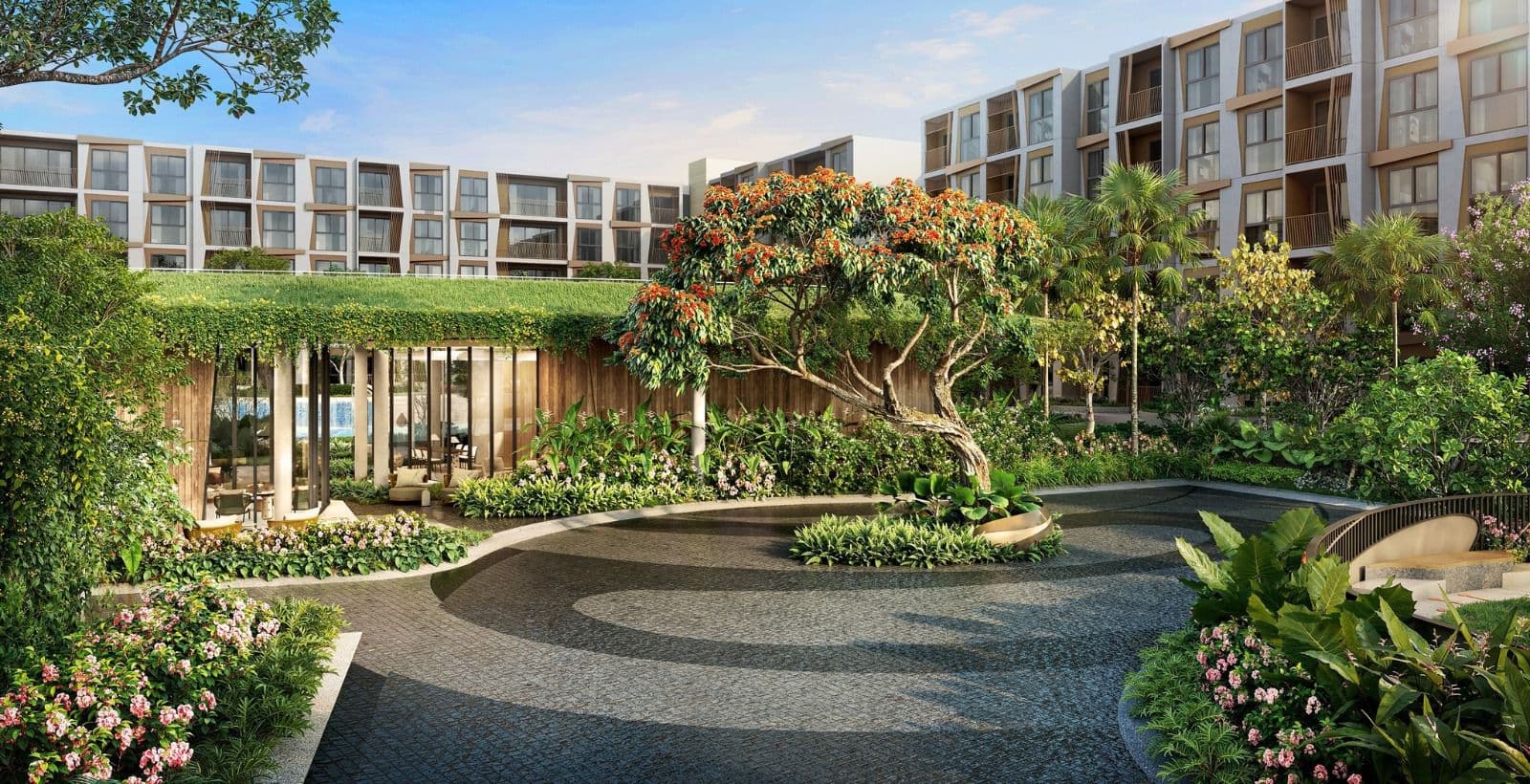
New residential supply in Surin is genuinely rare. A SET-listed developer building within walking distance of both Surin and southern Bang Tao Beach is rarer still. Rhea by Sansiri centres on three low-rise buildings (5 storeys maximum), 295 units, and a 900-sqm landscaped lagoon that forms the development's visual and social core. A dedicated pet park and designated pet units place it firmly in the lifestyle and long-term residency bracket rather than the high-density resort formula common further north.
Pricing sits at ฿143K to ฿186K per sqm at handover, which lands at parity or a slight discount to sister project CANVAS Cherngtalay despite Rhea's materially stronger coastal position. Every unit is delivered fully turnkey: furniture, appliances, and one year of PLUS Concierge service included. Sansiri's SET-listed corporate structure, Chanote land title, and the EIA approved 30 March 2026 give this one of the cleaner legal foundations available in off-plan Phuket. Foreign quota is roughly 30% remaining as of mid-2026.
⚖︎ The honest trade-offs
No sea views. The 23-metre west-coast height cap means upper floors get filtered tree-line glimpses at best. If views are the purchase driver, look elsewhere.
Modest rental yields. Realistic net STR yield sits at 3.2% to 4.3%, not the 5%+ gross figures often cited for Bang Tao condotels. Investors chasing yield should look at condotel stock in Bang Tao instead.
18-month wait. Construction starts May 2026 with handover targeted November 2027.
Unit selection matters. Ground-floor pool-access units trade natural light and privacy for direct lagoon connection. Upper-floor units flip that trade-off. Neither is wrong; it depends on how you plan to use the property.
For lifestyle buyers, pet owners, and long-term residents who value location scarcity over volume and yield, this is one of the more interesting Phuket launches this cycle. Genuine dual-beach walking access is rare on the west coast. If you are primarily chasing yield, it is probably not the right fit.
View Rhea by Sansiri on the Hawook platform →🌍 Secondary Story
APAC's Supply Drought Is About to Become Someone's Advantage
Three years of under-building across Asia-Pacific are now creating the conditions for a meaningful recovery. Oxford Economics research published via Mingtiandi concludes that higher development costs, financing constraints, and reduced land acquisitions since 2022 have materially thinned the forward project pipeline across the region. The consequence: ambient occupier demand will absorb existing space faster than new completions arrive, pulling down vacancy rates and supporting rent growth across office, hotel, and industrial sub-sectors in most major Asian markets.
The macro capital data is supportive. The ANREV/INREV/NCREIF 2026 Fund Manager Survey reported a 19% jump in global unlisted real estate AUM to $4.5 trillion, marking the first annual increase since 2021. Singapore-based CapitaLand Investment held the top APAC spot. Institutional capital is returning to the sector after three years of caution, and the preferred targets are logistics platforms, data centres, and prime operational hospitality.
For cross-border investors operating at smaller ticket sizes, the pattern worth tracking is which residential markets share the same supply constraint logic. Thailand's Greater Bangkok carries over THB 1.3 trillion in unsold residential stock, with new condo launches restricted to roughly 15,000 units in 2026, the lowest launch volume in well over a decade. Johor's cross-border demand thesis is being validated by physical infrastructure spending rather than promotional marketing. Vietnam's regulatory reforms are lowering institutional entry barriers. These are different stories, but the structural logic connecting them is the same: less new supply plus recovering demand equals a better outcome for existing assets.
🇹🇭 Thailand: Foreign buyer quality is rising
REIC data for Q2 2026 shows condominium transfers to foreign buyers rebounded to 3,292 units, with transfer value jumping 20.2% year-on-year to THB 14.8 billion despite flat unit volumes. American buyers averaged THB 6.6 million per unit (the highest of any nationality). Indian buyers purchased the largest average unit sizes at 72.1 sqm. The shift is away from speculative micro-unit purchases toward higher-value, larger end-user residences. That is a healthier composition than the preceding years.
🇲🇾 Regional Update: Malaysia
Johor's Price Gap to Singapore Is Now a Structural Trade, Not a Curiosity
The Star's 21 September market analysis confirms Malaysia's property sector is on track for steady growth in 2026, led by Johor, Selangor, and Penang. The mechanism driving Johor is concrete: physical infrastructure surrounding the Johor-Singapore Special Economic Zone (JS-SEZ) and the Forest City Special Financial Zone is drawing industrial relocations, data centre investments, and cross-border housing demand simultaneously.
The numbers that make this trade tangible: average Johor residential prices sit at RM487,128. Singapore resale HDB flats average approximately RM2.1 million. That is a 4.3x gap sustained across a 20-minute commute corridor. As the RTS Link rail connection advances and the JS-SEZ employer base grows, that gap becomes difficult to explain away for anyone with a Singaporean income and flexibility on where they sleep.
The Star's buyer analysis from 6 September identifies a structural shift in the Chinese buyer profile: speculative off-plan purchasers have largely been replaced by end-user families seeking second homes, education placement, and residency pathways. Capital is moving toward completed luxury landed homes and prime urban residences. For sellers of completed stock in Johor and KL, that is welcome news.
🚩 Regulatory note: MM2H easing request
Johor state authorities have formally requested the federal government to relax MM2H conditions, including reducing liquid asset and deposit minimums, to unlock absorption of over 6,000 unsold high-rise service apartments valued at RM4.7 billion. No federal decision yet. If MM2H conditions ease, Johor's foreign buyer pool widens meaningfully and that overhang clears faster. Watch for a federal response in Q4 2026.
📈 Personal Finance Hack
Thai Banks Reject 40% of Mortgage Applications. Here Is What They Are Actually Scoring.
Thailand's commercial banks currently reject approximately 40% of mortgage applications on mass-market residential properties, according to data cited by three major trade associations in a formal government submission. That number is high by global standards. Understanding exactly what banks assess can save you months of wasted time and preserve your negotiating position with a developer.
✅ What Thai banks actually score (in approximate priority order)
1. Debt Service Ratio. Banks typically want your total monthly debt commitments (including the proposed mortgage payment) below 40% to 45% of verifiable monthly income. Existing car loans, hire purchase, and even credit card minimum payments all count. This is where most rejections happen.
2. Income verification. For foreign applicants, Thai banks generally require an employment letter, 12 months of bank statements from your home country, and often a certified Thai translation. Freelance income and dividend distributions are accepted at some banks but discounted significantly in the calculation.
3. Thai credit footprint. Most foreign buyers have no Thai credit history, which banks handle by requiring a higher deposit: typically 30% to 40% down rather than the 10% to 20% available to qualifying Thai nationals.
4. LTV limits (just eased). The Bank of Thailand recently relaxed loan-to-value limits to improve accessibility in response to the rejection rate data. This helps the arithmetic but does not fix the underlying income verification challenges for foreign applicants.
Practical move: Speak with a bilingual mortgage broker who has established relationships with Thai banks before selecting a project. Not all banks treat foreign income equivalently, and the gap between the most and least foreign-friendly lenders on approval rate is significant. Getting a conditional pre-assessment before you sign a sales and purchase agreement is far cheaper than losing your deposit.
⚡ Around the Region: Quick Hits
🏳️ Vietnam: VinFast Steps Into Hanoi Real Estate
Nasdaq-listed EV maker VinFast acquired 100% of Ngoc Hoi Real Estate Investment on 16 September, securing a controlling stake in a large-scale Hanoi urban development project. The corporate logic: use prime real estate cash flows to finance international EV expansion. This is a treasury strategy wearing a property deal's clothes, and it signals how Vietnam's largest domestic groups are using land holdings as balance sheet anchors during high-growth phases. Worth watching as a signal of domestic corporate confidence in Hanoi land values.
🇵🇭 Philippines: Industrial Runs Hot, PE Backs Flex Office
Colliers Philippines reports 84% of surveyed industrial occupiers plan to expand their logistics footprints after warehouse vacancies dropped sharply in H1 2026, with high-value manufacturing, electronics assembly, and e-commerce all pulling space. Separately, Hillhouse Capital (via Rava) and Table Space agreed to acquire a controlling stake in KMC Solutions, Manila's largest flex office operator. Two different asset classes, same underlying read: occupier confidence in the Philippines is building.
🇰🇭 Cambodia: Local Buyers Now Drive Phnom Penh Condos
The Cambodia Condo Investment Guide 2026 documents a structural shift: domestic Cambodian buyers and renters now represent a growing share of condo market absorption in Phnom Penh, replacing the historically dominant foreign speculative base. Developers are reconfiguring floor plans and amenity packages toward middle-income Cambodian households. This is generally a more sustainable demand foundation than speculative offshore pre-sales, and it suggests the market is maturing in useful ways.
🇮🇩 Indonesia: Jakarta Industrial Land Pushes Past $181 Per Sqm
Greater Jakarta industrial land asking prices reached $181.59 per sqm in Q1 2026, with Subang leading regional appreciation on enhanced transport connectivity and growing manufacturing interest. On the office side, Colliers projects Jakarta's office sector reaches supply-demand equilibrium in 2026, supporting annual CBD rent growth of 2% to 3%. Two different asset classes, both pointing toward the same recovery inflection point.
📊 Numbers Worth Knowing
| Market / Metric | Figure | Source |
|---|---|---|
| Singapore 2026 investment sales forecast | S$60 billion (up from S$40B in Q1) | Savills, Sep 2026 |
| Singapore SORA benchmark rate | Approximately 1.34% | Savills, Sep 2026 |
| S-REIT equity raised YTD 2026 | Over S$4.5 billion | Business Times, Sep 2026 |
| Singapore prime residential growth (H2 2026) | +2.0% to +3.9% (forecast) | Savills World Cities Index |
| Global unlisted real estate AUM (year-end 2025) | $4.5 trillion (+19% year-on-year) | ANREV/INREV/NCREIF 2026 |
| Thailand Q2 2026 foreign condo transfers | 3,292 units; transfer value +20.2% YoY | REIC Thailand, Sep 2026 |
| Bangkok bank mortgage rejection rate | Approximately 40% (mass-market segment) | Trade associations, 2026 |
| Greater Jakarta industrial land asking price | $181.59 per sqm (Q1 2026) | Colliers Indonesia, Q1 2026 |
| Johor avg. residential price vs Singapore HDB resale | RM487,128 vs approx. RM2.1 million | The Star, Sep 2026 |
🏠 STR Investor Corner
The OTA Commission Trap: What Your Real Take-Home Rate Actually Is
Most short-term rental owners know that Airbnb and Booking.com take roughly 15% to 20% of the nightly rate. Fewer have run the full number. Here is what it actually looks like once you account for everything the platform extracts.
Take a ฿5,000 per night listing in Phuket. OTA host fee at 15%: ฿750 per night gone before you count anything else. At 70% annual occupancy (255 nights booked), that is ฿191,250 per year paid to the platform. Now layer in platform-driven promotional discounts (which the algorithm rewards with higher ranking), early-bird rate cuts, and seasonal price caps that OTA dynamic pricing tools push toward. The effective OTA cost on most properties runs 22% to 28% of gross revenue, not the advertised 15%.
📝 The calculation to run this week
Step 1: Pull your last 12 months of OTA payouts versus total booking revenue. The gap between those two numbers is your actual effective commission rate, not the rate the platform advertises.
Step 2: Calculate what one additional direct booking per month saves you. On a ฿5,000 room at a 25% effective OTA rate, 12 direct nights per year equals approximately ฿90,000 to ฿105,000 saved annually.
Step 3: Compare that saving against the cost of a direct booking channel. A basic booking website with a payment gateway runs ฿5,000 to ฿15,000 per year in this market. For any property generating more than ฿1 million in annual gross revenue, the maths strongly favour a direct channel investment.
Starting point: offer repeat guests a 10% rate advantage for direct booking versus your OTA listed rate. Frame it as a loyalty benefit rather than a discount. Most OTA terms permit this as long as you do not publicly advertise a lower price on your own site.
📋 Regulatory Tracker
| Country | Development | Buyer Impact |
|---|---|---|
| Thailand | Transfer and mortgage registration fees extended at 0.01% for properties up to THB 7 million. Bank of Thailand also relaxed loan-to-value limits to ease mortgage accessibility. | Lower transaction costs on mass-market purchases through mid-2027. Marginally improved mortgage access for domestic buyers; limited direct benefit for foreign buyers whose main hurdle is income verification. |
| Indonesia | 100% government-borne VAT incentive (PPN DTP) for qualifying residential purchases extended through 2027. | Meaningful cost saving on qualifying new residential purchases. Check threshold criteria and property type eligibility with a local tax advisor before transacting. |
| Vietnam | JLL ranks Vietnam in the global top 10 for real estate transparency improvement. National property database now live with 120 projects and approximately 3,500 active transactions registered. | Reduced due diligence friction on project legal standing. Does not replace local legal counsel but lowers the floor risk on a compromised development acquisition. |
| Malaysia | Johor formally requests federal relaxation of MM2H conditions, including lower liquid asset and deposit minimums, to reduce RM4.7 billion high-rise overhang. | No change yet. Federal response expected Q4 2026. Easing would expand Johor's foreign buyer pool materially and accelerate overhang clearance. |
A market question? A project to stress-test? A deal that needs a second opinion?
We research Southeast Asia property full-time. Reach us directly and we will give you a straight answer.
💬 Message us on WhatsAppFill out our quick form✍︎ Final Thought
The Cycle Is Turning. The Question Is Which Position You Are Holding.
Three data points this week are pointing in the same direction. Singapore's investment sales forecast is up S$20 billion in a single quarter. Global unlisted real estate AUM has recovered 19% after three consecutive years of contraction. APAC's forward supply pipeline is the thinnest it has been in a decade. No single one of these moves a market on its own. Together, they describe a system where institutional capital is re-engaging with property after an extended, cautious pause. That re-engagement phase, historically, tends to be when the best entry points close.
For most of our readers, the practical implication is not about chasing institutional deal flow. It is about positioning relative to supply. Markets with constrained forward supply (Bangkok's near-record-low new launch environment, Johor's pricing gap to Singapore, Phuket's genuinely limited west-coast coastal product) tend to reward patience. Markets with elevated pipelines tend to punish it. The supply story is not exciting to read. It is, however, probably the most reliable single predictor of what your property will be worth three to five years from now.
One more thing. Several of you wrote in after last week's Vietnam transparency piece asking whether the database reforms change the on-the-ground due diligence process for foreign buyers. The short answer: it helps, but it does not replace local legal counsel. Access to a mandatory project registry reduces your risk of buying into a legally compromised development. It does not tell you whether the developer will complete on time, whether the management company is competent, or whether your unit's title will transfer cleanly. Those questions still require field-level research and qualified local lawyers. We are building tools on the Hawook platform to help with exactly that. More soon.
The Hawook Weekly
Southeast Asia property intelligence for cross-border investors
hawook.comnews.hawook.coapp.hawook.com
This newsletter is for informational purposes only and does not constitute financial, legal, or investment advice. Property markets carry risk. Always conduct independent due diligence and consult qualified professionals before making investment decisions. Hawook does not accept liability for decisions made based on the content of this publication.